Category:
 Author:
 Date:Sep 18, 2026
Why Overtrading Is One of the Biggest Risks for Prop Traders
Every prop firm challenge comes down to one question: can you trade inside strict loss limits without breaking them? Most traders cannot. In the largest independent dataset available, covering more than 300,000 prop accounts across ten firms, only 14% of traders passed a challenge and just 7% ever received a payout. Prop firms and industry guides consistently name loss-limit breaches, above all the daily limit, as the most common way a challenge ends. And one of the behaviours most likely to turn a normal bad day into a breached limit is overtrading.
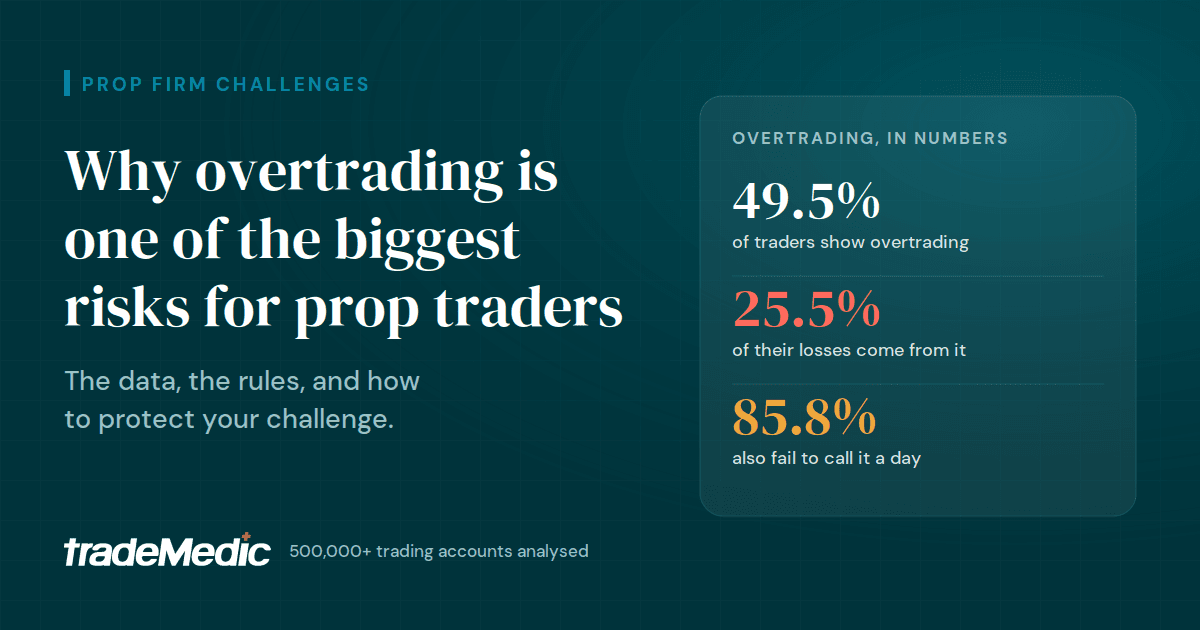
Across the 500,000+ trading accounts analysed by TradeMedic AI, overtrading shows up in almost every second trader. For the traders who have it, it causes about a quarter of their losses. Of the 23 problem patterns we track, it ranks in the top five both for how common it is and for the share of losses it causes. In a regular trading account, that is an expensive habit. In a prop challenge, with a daily loss limit of around 5%, it can end the account in an afternoon. TradeMedic AI detects overtrading, along with 60+ other behavioural patterns, directly from a trader's history, so the numbers in this article come from real trading behaviour rather than surveys or self-reports.
To see why the combination is so dangerous, start with how a challenge is built.
Why is overtrading so dangerous in a prop firm challenge?
A normal trading account oftentimes absorbs a bad day. You lose more than you planned, you close the platform, and you come back tomorrow with most of your capital intact. A prop challenge does not work that way. Every challenge has a daily loss limit, and crossing it ends the evaluation immediately, no matter how well the rest of the challenge has gone.
That rule is precisely what overtrading attacks. Overtrading means taking more trades than your edge can support, and the extra trades almost always happen on the same day: after a loss you want to recover, after a win that makes you feel sharp, or in a quiet market where doing nothing feels like falling behind. Many times, it is even the dopamine rush we are seeking, hence placing some more trades. Each additional trade adds risk to a day. The losses do not spread out over weeks. They pile up in one session, which is exactly what the daily loss limit is designed to catch.
Our analysis of why prop firm traders fail maps each way a challenge can end to the behaviour behind it. Overtrading is one of the most direct routes to a breached daily limit.
The mechanics become clearer once you put real prop firm rules next to a real overtrading day.
How prop firm rules turn overtrading into a failed challenge
Most prop challenges in 2026 cap daily losses at around 4% to 6% and total drawdown at around 6% to 12%. FTMO's standard challenge, for example, allows 5% a day and 10% in total, and counts open positions, commissions and swaps towards the daily figure.
On a $100,000 account, a 5% daily limit means one bad day can cost at most $5,000 before the challenge is over. Picture a trader who plans two trades, each risking 1%. Both lose, and the day stands at minus 2%, well inside the limit. But the trader keeps going. After a small win and four more losses, the seventh trade of the day takes the account to minus 5.5%, and the challenge is over.
No single trade was reckless, and the risk per trade never changed. The number of trades broke the challenge. With a rule set in advance, the same day ends very differently: a two-trade cap stops it at minus 2%, and a personal loss stop at minus 2.5% ends it after the fourth trade. Still a losing day, but the challenge survives.
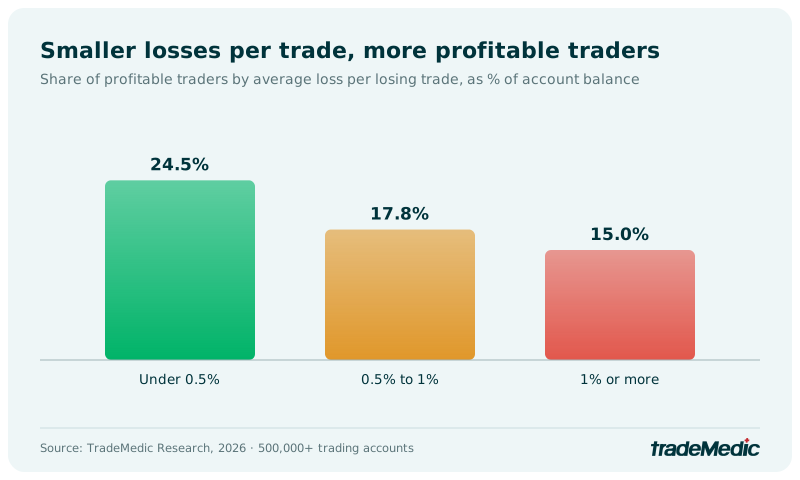
Risk per trade decides how many mistakes the limit can absorb. At 2% per trade, a 5% limit is gone after three losing trades; at 0.5%, it takes ten. The same seven trades at 0.5% end the day at minus 2.75% instead of minus 5.5%. Across 500,000+ trading accounts, traders whose losing trades cost them less than 0.5% of their balance on average are profitable 24.5% of the time. At 0.5% to 1%, it is 17.8%, and from 1% upward, 15.0%, below the 18.2% average. Our guide on how much to risk per trade covers the full analysis.
Repeated overtrading days also eat into the total drawdown: two or three of them can use up most of a 10% allowance.
So how likely is it that you carry this pattern into a challenge? The data gives a clear answer.
How common and costly is overtrading?
Overtrading is detected in 49.5% of the traders in our dataset. For 40.3% it is one of their five biggest improvement areas, which makes it the third most common top-five issue among the 23 problem patterns we track. Among the traders who show it, overtrading causes 25.5% of their losses, an average of $7,248 per trader.
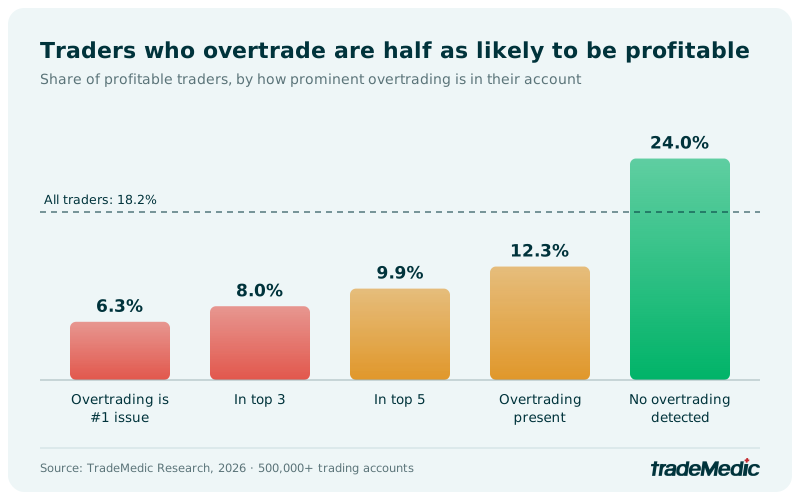
The link to profitability is just as clear. Only 12.3% of traders with overtrading are profitable, compared with 24.0% of traders where it is not detected. When overtrading is a trader's single biggest issue, only 6.3% are profitable.
One finding matters especially for prop traders. Overtrading is not a beginner problem. It is detected in 15.4% of accounts under 10 days old, but in 70.3% of accounts trading for 200 days or more, and from 50 days onward it is the most common issue in traders' top five. Many traders buy a challenge after trading their own account for a while. If that describes you, overtrading is statistically the pattern most likely to come with you into the challenge.
These figures come from regular trading accounts, not challenge accounts. The behaviour is the same in both. What changes under prop rules is how quickly it gets punished.
And overtrading rarely arrives on its own, which makes a daily limit even easier to break.
Why overtrading rarely comes alone
When overtrading is detected in an account, other patterns show up more often too, and three of them are especially dangerous under a daily loss limit.
85.8% of traders who overtrade also fail to call it a day, compared with 75.6% of all traders. Failing to call it a day means results get worse after a large daily gain or loss, because the trader keeps going instead of stopping. In a challenge, that is the exact sequence that breaks a daily limit: a bad start, followed by more trades to recover it.
58.4% of traders who overtrade also trade without taking breaks, compared with 46.2% of all traders. Trading without breaks leaves no time to step back and check where the day stands against the limit.
25.9% of traders who overtrade also run too many positions at once, compared with 20.3% of all traders. Trading too many positions at once matters more in a prop account than almost anywhere else, because at many firms open losses count toward the daily limit before any trade is closed.
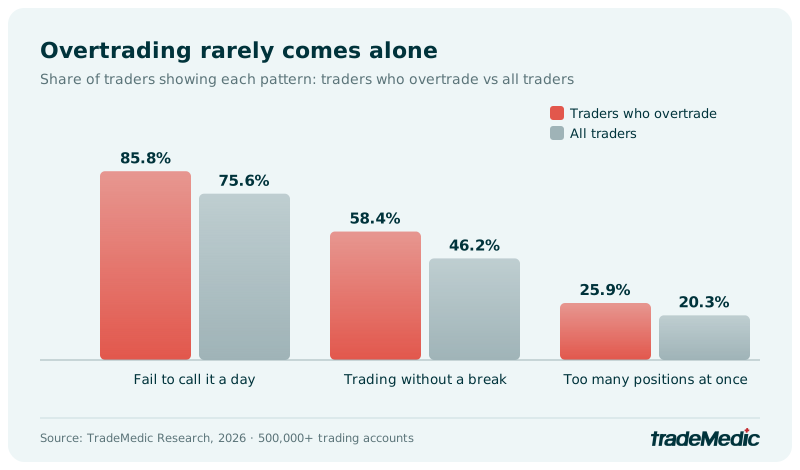
Together, these patterns describe a very specific kind of day: a trader who does not stop after a bad start, trades back to back without pausing, and stacks positions while doing it. It is hard to design a more reliable way to reach a daily loss limit.
Part of what makes this so common in challenges is the challenge itself.
Why prop challenges make overtrading even more likely
A challenge adds pressures a normal account does not have, and most of them push towards more trades. The profit target turns every quiet session into lost progress. The fee, already paid, makes a sensible "no trade today" feel like wasting the challenge. And minimum trading day rules tempt some traders to place trades just to fill the days, which is overtrading by definition. We cannot measure these pressures in our data, but they come on top of the usual drivers covered in our main article on overtrading: the brain's reward response to placing a trade, the discomfort of doing nothing, and the confidence that follows a few wins.
The good news is that the data also shows what the traders who avoid this look like.
How to protect your prop challenge from overtrading
[Selective Trades](/blogs/behavioral-edges/selective-trading-edge), the strength of performing better on days with fewer trades, appears in 56.0% of profitable traders, compared with 34.3% of loss-making traders. And 48.3% of traders who [recover calmly after a loss](/blogs/behavioral-edges/how-to-recover-from-trading-losses) are profitable, more than two and a half times the 18.2% average. Neither is a talent. Both are habits, and the steps below are built to create them.
1. Know your number before you buy the challenge. Overtrading is personal. Across all traders, the share of profitable traders falls sharply up to around ten trades a day, as covered in our analysis of how many trades per day to make. But your own limit may be three trades or twenty. Find it in your existing trade history before you pay for a challenge, not during it.
2. Set a daily trade cap below your number. Decide it before the session, write it down, and treat reaching it as the end of the day. In a challenge, the cap protects both your edge and your daily loss limit.
3. Set a personal daily loss stop well inside the firm's limit. Many prop traders stop for the day at around half of the firm's daily limit, for example 2% to 2.5% on a 5% limit. That leaves room for slippage, open positions and one more bad trade, and it takes the decision out of the moment when it is hardest to make.
4. Stop after a big win or a big loss. Both change how the next setup looks to you. Given how often overtraders also fail to call it a day, this single rule removes one of the most common paths to a breach.
5. Count your open positions. Before adding a new position, check what your open trades would cost you if they all hit their stops. At firms that count floating losses, that is part of your daily loss already.
6. Plan your minimum trading days. If your firm requires a minimum number of trading days, plan how you will meet them with your normal setups, rather than forcing trades on days when nothing qualifies.
The first of these steps is the one most traders skip, because it needs data they do not usually have.
How TradeMedic AI helps prop traders
TradeMedic AI analyses MT4 and MT5 trading accounts, including prop firm accounts. It groups your trades by how many trades you had already placed that day and checks whether your results get worse as the count climbs. If they do, overtrading is flagged, and you see the daily trade range where your results start to slip, along with what the trades beyond it have cost you in dollars.
The same analysis checks for the companion patterns that matter most under prop rules, such as failing to call it a day and trading without breaks, and for strengths that protect you, such as Selective Trades. Running it on your existing account before a challenge shows you which habits you would be taking into the evaluation, while there is still time to change them.
The bottom line
Overtrading is one of the most common and most costly patterns in trading. It shows up in almost every second account, it causes about a quarter of affected traders' losses, and it becomes more common the longer traders have been trading. Under prop firm rules, its cost changes shape: instead of a slow drain on the account, it becomes a single day that ends the challenge. The traders who protect their challenges know their daily trade limit before they start, stop well inside the firm's loss limits, and treat a day with no setup as a day that followed the rules.
→ Learn more about TradeMedic AI
Research behind this article
TradeMedic Research (2026). Behavioural pattern analysis of 500,000+ retail trading accounts. Source: TradeMedic Research, 2026.
FPFX Tech (2024). Analysis of 300,000+ prop trading accounts from 100,000 traders across 10 firms, reported exclusively by Finance Magnates, September 2024.
Prop firm rule ranges: For Traders (2026), Prop Trading Rules You Must Know Before Taking a Challenge, snapshot of eight firms as of August 2026.
FTMO standard challenge parameters (5% maximum daily loss, 10% maximum loss, open positions, commissions and swaps included in the daily calculation), as published in FTMO's challenge rules, 2026.
Frequently asked questions
Why is overtrading dangerous in a prop firm challenge?
Prop challenges have a daily loss limit, usually around 4% to 6%, and crossing it ends the challenge. Overtrading concentrates extra trades, and their losses, into a single day, which is exactly what the daily limit is designed to catch. A habit that would only cost money in a normal account can end a challenge in one session.
How common is overtrading?
Across 500,000+ trading accounts analysed by TradeMedic AI, overtrading is detected in 49.5% of traders, and 40.3% have it among their five biggest improvement areas. Among the traders who show it, it causes 25.5% of their losses.
How many trades per day should I take in a prop firm challenge?
There is no universal number. In TradeMedic AI data from 500,000+ trading accounts, the share of profitable traders falls sharply up to around ten trades a day and then levels off, but each trader's limit is different. The safest approach is to find the daily trade count where your own results start to slip, and cap your challenge trading below it.
Does the daily loss limit include open positions?
At many prop firms it does. FTMO, for example, counts open positions, commissions and swaps in its daily loss calculation. Check your firm's rules, and count what your open trades would cost if they all hit their stops before adding a new one.
What is a good personal daily loss limit for a prop challenge?
Many prop traders stop at around half of the firm's daily limit, for example 2% to 2.5% on a 5% limit. That leaves room for slippage, open positions and mistakes. The right level depends on your risk per trade and strategy.
How much should I risk per trade in a prop challenge?
It depends on your strategy, but smaller is safer under a daily loss limit. At 2% risk per trade, a 5% daily limit is breached after three losing trades; at 0.5%, it takes ten. According to TradeMedic AI data from 500,000+ trading accounts, traders whose losing trades average under 0.5% of their balance are profitable 24.5% of the time, against 15.0% for those averaging more than 2%.
Is overtrading the main reason traders fail prop challenges?
Prop firms and industry guides consistently name loss-limit breaches as the most common way challenges end, and overtrading is one of the behaviours most likely to drive a breach, often together with failing to call it a day. The TradeMedic dataset covers regular trading accounts, so it shows how common and costly overtrading is rather than measuring prop pass rates directly.
Are experienced traders less likely to overtrade?
No. In TradeMedic AI data from 500,000+ trading accounts, overtrading is detected in 15.4% of accounts under 10 days old but in 70.3% of accounts trading for 200 days or more. Traders who buy a challenge after trading their own account for a while are more likely, not less, to bring the pattern with them.
Can TradeMedic AI analyse a prop firm account?
Yes. TradeMedic AI analyses MT4 and MT5 accounts, including prop firm accounts, and detects overtrading and 60+ other behavioural patterns from the trade history. Running it on your existing account before a challenge shows which habits you would take into the evaluation.