Category:
 Author:
 Date:Sep 18, 2026
Is Trading Gambling? What 500,000 Trading Accounts Reveal

Is trading gambling? It is one of the most common questions new traders ask, and one of the most uncomfortable ones for experienced traders to answer honestly. In this article we take a data-driven approach to answer this question. Most retail traders lose money. European regulators found that 74% to 89% of retail accounts trading CFDs lose money, and across the 500,000+ trading accounts analysed by TradeMedic AI, only 18.2% of traders are profitable.
From the outside, those numbers look a lot like a casino. But the data also shows something a casino never could: the odds are not the same for everyone. They change dramatically with how a trader behaves.
That is something we can measure. TradeMedic AI analyses each trading account for more than 60 behavioural patterns, from habits that cost money to strengths that make it. Applied across 500,000+ accounts, that makes it possible to compare the traders who win with the traders who lose, not just count them. This article looks at what separates trading from gambling, what the data says about who wins and who loses, and how to tell which one you are doing.
Is trading gambling? The short answer
Trading is not gambling by design, but it can become gambling in practice. The difference is not the market or the instrument. It is the behaviour of the person placing the trade.
A casino game is built so that the house wins over time, no matter what the player does. The rules fix the odds, and no decision the player makes can change them. Trading has no built-in house edge of that kind. Costs like spreads and fees mean the average trade starts slightly behind, but whether a trader ends up ahead depends on decisions: which trades to take, how much to risk, when to exit and when to stop. Those decisions can be made with rules, or on impulse. The more they are made on impulse, the more trading starts to behave like gambling.
To see where that line sits, it helps to be precise about what gambling is.
Trading vs gambling: what is the difference?
Three things define a classic gambling game. The expected return is negative by design, set by the house. Each outcome is independent of what the player knows or does. And no amount of practice or discipline changes the long-run result.
Trading differs on all three, at least in principle. There is no house setting the odds. Prices respond to information, and traders can use rules to decide when to act and when to stay out. And behaviour changes results: the same market produces very different outcomes for different traders.
European regulators draw a similar line. When ESMA restricted CFDs for retail clients in 2018, it pointed to excessive leverage as the problem. For binary options, which it banned outright, it pointed to a structural negative expected return, the defining feature of a gambling product.
But in principle is doing a lot of work. The question is not whether trading can be different from gambling. It is whether it is different in the way most people trade. That is where the data comes in.
Is day trading gambling? What 500,000 trading accounts show
Across more than 500,000 trading accounts, 18.2% of traders are profitable. That is in line with what regulators see across the industry, and it is covered in more detail in our analysis of how many day traders are profitable. On its own, it is a sobering number. If you pick a trader at random, the odds are more than four to one that they are not profitable.
But the average hides a very wide spread. Among traders who perform well in ranging markets, 60.2% are profitable. Among traders who perform well in calm, low-volatility markets, 52.6% are. Among traders who recover calmly after a loss instead of trying to win it straight back, it is 48.3%. All of these are well above the 18.2% average.
At the other end, the numbers fall sharply. Among traders who double down on losing positions, only 7.2% are profitable. Among traders who trade without taking breaks, it is 5.4%. Among traders who overtrade, 12.3%.
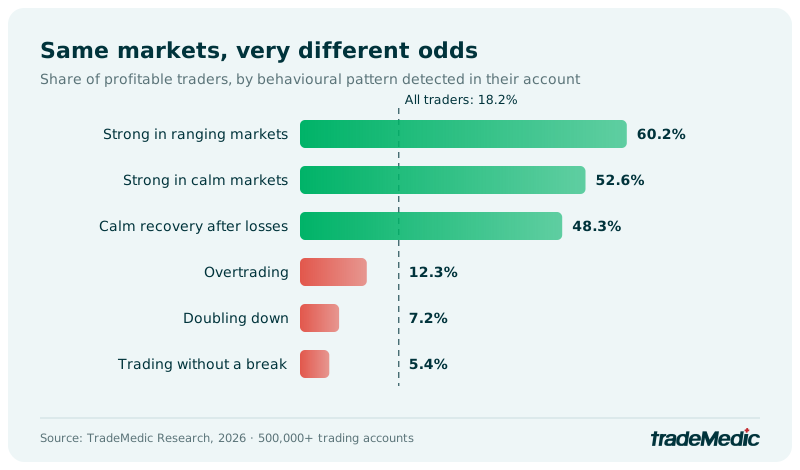
These traders operate in the same markets, with the same instruments and the same costs. What differs is how they trade. In a casino, the player's behaviour does not change the house edge. In trading, behaviour is what moves the odds from one in five to better than one in two, or down to close to one in twenty.
Two simple habits show how far behaviour can move the odds. Traders who place fewer than two trades on an average day are profitable 33.0% of the time. Traders who keep more than 99% of their trades in a single symbol are profitable 25.6% of the time. Traders who do both are profitable 46.2% of the time, two and a half times the average.
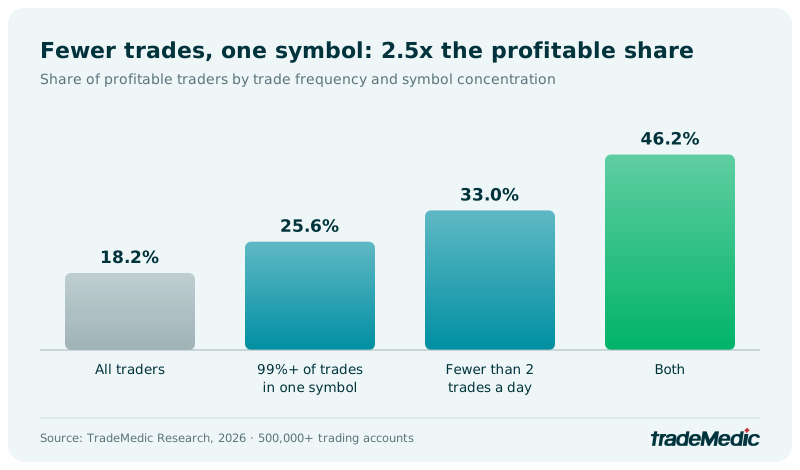
It is the opposite of how a gambler plays. A gambler places many bets across many tables. These traders wait for one setup in a market they know well. They are also rare: fewer than one trader in 270 meets both conditions. And more than half of them (53.8%) still lost money, which is an important caveat. Patience and focus remove many of the ways a trader can destroy an edge, but they do not create one. We cover this group in detail in our analysis of one trade a day in one symbol.
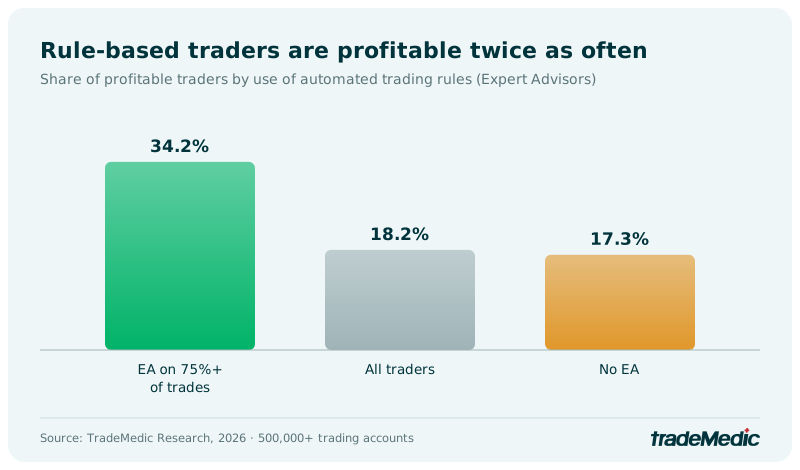
One more comparison makes the point. Traders who run more than 75% of their trades through automated rules, known as Expert Advisors, are profitable 34.2% of the time, compared with 17.3% for traders who never use them. This does not mean automation is a shortcut to profit. Traders who build rule-based systems are likely to differ in other ways too, such as experience and preparation. But it shows how much consistent, rule-based decisions are associated with better outcomes than decisions made in the moment.
The market itself makes less difference than most traders think, with one exception. By main traded instrument, the share of profitable traders ranges from 11.1% for NAS100 to 20.4% for GBPUSD. Gold (XAUUSD), the main instrument for 65.9% of the traders in the dataset, sits at 17.7%, and EURUSD at 19.2%.
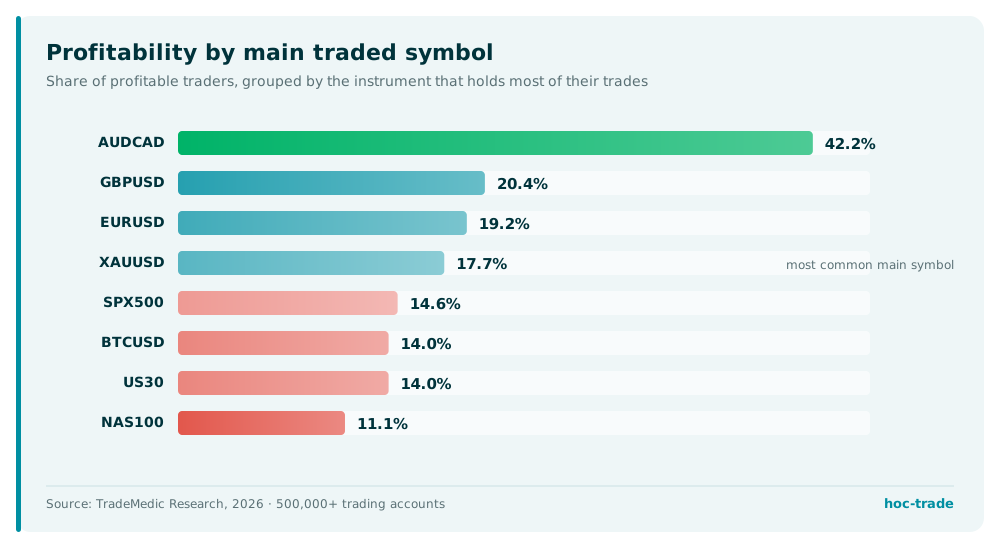
The exception is AUDCAD. Traders whose main pair is AUDCAD are profitable 42.2% of the time, more than twice the average. It is a small group of 5,950 traders, and the pair has a particular character: it tends to move slowly and within ranges, which attracts range-trading and carry approaches. Automation does not explain it either. Excluding traders who use Expert Advisors on more than 25% of their trades barely changes the figure (41.3%).
That does not make AUDCAD a shortcut. A pair that suits a patient, range-based approach can reward that behaviour, but it offers no protection to a trader who trades it impulsively. It fits the rest of the data: traders who perform well in ranging markets are profitable 60.2% of the time, and the outcome follows the behaviour more than the instrument. We rank every instrument in our analysis of the best forex pair to trade.
If behaviour decides the odds, the next question is which behaviours push trading towards gambling.
When does trading become gambling?
Trading starts to behave like gambling when decisions stop following a plan and start following feelings: the urge to win back a loss, the excitement of a winning streak, or the restlessness of a quiet market. These are the patterns that show up most clearly in the data.
Raising the stakes after a loss. Adding to a losing position in the hope that it turns around is one of the most gambling-like behaviours in trading. Doubling down is detected in 46.5% of traders, and only 7.2% of those traders are profitable.
Trying to win it back. Re-entering the market straight after a loss to recover it is the trading version of chasing. Only 14.6% of traders who show revenge trading are profitable.
Trading for the sake of trading. Taking trades because the market is moving, rather than because a setup appeared, turns a strategy into a stream of bets. Overtrading is detected in 49.5% of traders, and trading without breaks in 46.2%. Only 12.3% and 5.4% of those traders are profitable.
Betting on reversals. Trading against a strong move in the belief that it must turn soon relies on a hunch rather than evidence. Only 9.8% of traders who keep fighting the trend are profitable, and 10.2% of those who try to catch a falling knife. The belief behind it is often the gambler's fallacy: the idea that after a run of one outcome, the opposite is due.
Trading without a defined exit. Opening a position without a stop loss leaves the outcome of the trade open-ended, closer to a bet than a plan.
None of these behaviours is unusual. Most traders show several of them at some point. That is why the question is less about whether you trade and more about how much of your trading is driven by patterns like these.
What makes trading different from gambling in practice
The traders who beat the average tend to share a few habits, and none of them has anything to do with finding the perfect indicator.
They know which market conditions suit them. The traders with the highest profitability in the dataset are those who perform well in specific conditions, such as ranging or calm markets, and whose results show it consistently. They know where their edge is, and by implication, where it is not. Traders who can stay patient in low-volatility markets are a good example.
They handle losses without chasing. Recovering calmly after a loss is associated with a profitability rate of 48.3%, more than two and a half times the average.
They focus. Traders who concentrate on the markets they know best do better than those who spread across many. Symbol focus, performing better with fewer instruments open at once, is detected in 11.5% of traders, and 39.1% of them are profitable.
They trade less. They wait for their setup instead of taking whatever the market offers. As shown above, traders averaging fewer than two trades a day are profitable almost twice as often as the average trader.
They follow rules they set in advance. Whether through an automated system or a written plan, decisions made before the session tend to hold up better than decisions made in the middle of it.
How to tell if you are trading or gambling
You do not need to wait for a bad month to find out which side you are on. A few honest questions go a long way.
Can you name the setup before you enter? If the only reason for a trade is that the market is moving or that you want to be in it, it is closer to a bet than a trade.
Do you change your size after a loss? Increasing risk to recover a loss is the clearest line between trading and gambling.
Do you know where your edge is? A trader should be able to say which markets, sessions or conditions produce their best results. If you cannot, you are trading without knowing your odds.
Do your results depend on a few big wins? A trading approach that works shows up across many trades. If most of your profit came from a handful of lucky trades, your record may say more about luck than about skill.
The difficulty is that these patterns are hard to see from the inside. Every individual trade feels reasonable when you place it. TradeMedic AI analyses your full trade history and shows which behaviours are costing you money, which strengths are working for you, and how your results compare with 500,000+ other traders. It turns the question "am I trading or gambling?" into something you can measure.
The bottom line: is trading gambling?
Trading is not gambling by design. There is no house edge fixing the outcome, and the same markets produce very different results for different traders. But most retail traders lose, and the data shows why: the behaviours that dominate losing accounts, such as doubling down, chasing losses and trading without a plan, are the same behaviours that make trading work like a bet. The traders who beat the average trade on rules, know where their edge is and handle losses calmly. Whether trading is gambling comes down to which of those two groups your behaviour puts you in.
→ Learn more about TradeMedic AI
→ Find out which behaviours drive your results: connect your trading account to TradeMedic AI free
Research behind this article
European Securities and Markets Authority (2018). ESMA agrees to prohibit binary options and restrict CFDs to protect retail investors. Press release, 27 March 2018.
TradeMedic Research (2026). Behavioural pattern analysis of 500,000+ retail trading accounts. Source: TradeMedic Research, 2026.
Frequently asked questions
Is trading gambling?
Trading is not gambling by design, because there is no house edge fixing the outcome and trader decisions change results. But it can become gambling in practice when decisions are driven by impulse rather than rules. According to TradeMedic AI data from 500,000+ trading accounts, profitability ranges from 5.4% to over 60% depending on the behaviour traders show.
Is day trading gambling?
Day trading is not gambling in itself, but most day traders lose money: in TradeMedic AI data from 500,000+ trading accounts, 18.2% of traders are profitable. The difference between the winners and the rest is largely behavioural, such as how traders handle losses and whether they follow rules they set in advance.
What is the difference between trading and gambling?
Gambling games have a negative expected return set by the house, and player decisions cannot change the long-run result. In trading there is no house edge, and behaviour changes outcomes. The same markets produce very different results depending on how traders manage risk, handle losses and choose their trades.
Is forex trading gambling?
Forex trading is not gambling by design, but it carries high risk. The European Securities and Markets Authority (ESMA) found that 74% to 89% of retail CFD accounts, which include rolling spot forex, lose money. Most accounts in the TradeMedic dataset trade forex, gold and indices, and their results vary strongly with trading behaviour.
Is trading like gambling?
Trading can feel like gambling because outcomes are uncertain and most retail traders lose. It starts to work like gambling when traders raise their stakes after losses, chase losses or trade without a plan. Traders who follow rules and know where their edge is have far better odds.
Does trading less make it less like gambling?
Less than most traders think. In TradeMedic AI data from 500,000+ trading accounts, the share of profitable traders by main instrument ranges from 11.1% for NAS100 to 20.4% for GBPUSD, with gold at 17.7%. AUDCAD is an outlier at 42.2%, but it is a small group and the pair suits patient, range-based trading. Behaviour moves the odds far more than the instrument does.
How can I tell if I am trading or gambling?
Ask whether you can name the setup before every trade, whether you increase your size after losses, whether you know which conditions produce your best results, and whether your profits come from many trades or a few lucky ones. Tools like TradeMedic AI analyse your trade history to show which behaviours drive your results.
Is day trading just gambling?
No, but it can become gambling-like when trades follow impulse rather than rules. In TradeMedic AI data from 500,000+ trading accounts, traders who perform well in ranging markets are profitable 60.2% of the time, while traders who trade without taking breaks are profitable only 5.4% of the time. The same markets produce very different results depending on behaviour.