Category:
 Author:
 Date:Jul 9, 2026
AI Trading Analysis Tools in 2026: Coaches, Mentors, and the Behavioral Analytics Difference

Search for an AI trading tool today and you get a wall of products that all claim the same thing: they will make you a better trader. Some promise to teach you setups. Some promise to chat with you about your session. Some promise to detect the habits quietly draining your account. They are not the same kind of tool, and treating them as interchangeable is how traders end up paying for something that does not solve their actual problem.
The distinction that matters is simple. Some AI tools analyze the market to help you decide what to trade. Others analyze you to show you how you trade. This guide focuses on the second group, the tools built around your own trade history, and explains where AI trading coaches, AI trading mentors, and behavioral trading analytics differ. The framing draws on patterns observed across a dataset of more than 500,000 trader accounts, which is the vantage point behind TradeMedic AI.
What are the main types of AI trading tools?
When people type ai trading tools into a search bar, they are usually looking for one of three different things without realizing it. The first is market analysis: scanners, signal generators, and bots that read price action and surface trade ideas or place orders. The second is education: tools that teach strategy, drill mechanical rules, and help you build a trading plan. The third is self-analysis: tools that read your completed trades and tell you what you are doing well and what is costing you money.
Google's own AI answers now split the coaching and analysis space into two buckets, behavioral or analytical tools that plug into your data, and strategy or educational tools that teach you technique. That split is the useful one. It cuts through the marketing, because almost every product describes itself as an AI trading coach regardless of which job it does. Once you know which bucket a tool sits in, you can judge whether it fits the problem you are trying to fix.
What is an AI trading coach?
An AI trading coach is software that reviews your trading and gives you feedback on it. The stronger ones work on your real trade data rather than on screenshots you paste into a chatbot, so their feedback reflects your actual entries, exits, sizes, and timing. A good coach tends to do a few things: check whether you followed your own rules, flag where your plan and your execution diverged, and point you toward the single highest-cost habit to fix first.
The category has shifted fast. Products that launched as coaches are now rebranding toward AI trading partner or AI trading agent, language meant to signal that the tool takes action for you: tagging trades, writing session notes, generating a next-day plan. That action layer is useful if you are an active day trader logging many trades a session and drowning in manual review. It is less relevant if what you need is not more workflow automation but a clear, objective read on the behaviors hurting your results.
What is an AI trading mentor, and how is it different from a coach?
In practice the terms coach and mentor get used interchangeably, but there is a soft distinction worth knowing. Mentor language leans toward teaching and guidance: explaining concepts, drafting rules for a strategy, helping you think through a losing streak. Coach language leans toward review and accountability: scoring your discipline, flagging rule breaks, holding you to your plan. Some tools blend both. A mentor-style tool trained on trading literature can be a strong learning companion, though it typically speaks in general principles rather than reading your specific account.
The limitation of both, when they rely on conversation, is that they only know what you tell them. If you have to re-explain your style every session, or log how you felt before each trade, the quality of the feedback depends on the quality and honesty of your self-report. That is a real constraint, because the behaviors that cost traders the most are often the ones they are least aware of and least likely to log accurately.
What is behavioral trading analytics?
Behavioral trading analytics is the third approach, and it is where TradeMedic AI sits. Instead of teaching you strategy or chatting about your session, it reads your full trade history and detects recurring behavioral patterns directly from the data. No mood diary to fill in, no setup to describe from memory. The patterns are already in your executed trades: how you behave after a loss, how your performance changes as you add trades through the day, when you enter late, when you exit early.
The difference from a conversational coach is that detection is automatic and evidence-based. A tool that depends on you tagging your own trades or logging your emotions can only surface what you were aware of. Automated behavioral analysis surfaces what you were not. Across the TradeMedic dataset of more than 500,000 trader accounts, every trader analyzed with a meaningful trade history had at least one improvement area in their data, including consistently profitable ones. Self-report alone rarely catches that, because the blind spots are, by definition, the parts you cannot see.
Which AI tools quantify the cost of your trading habits?
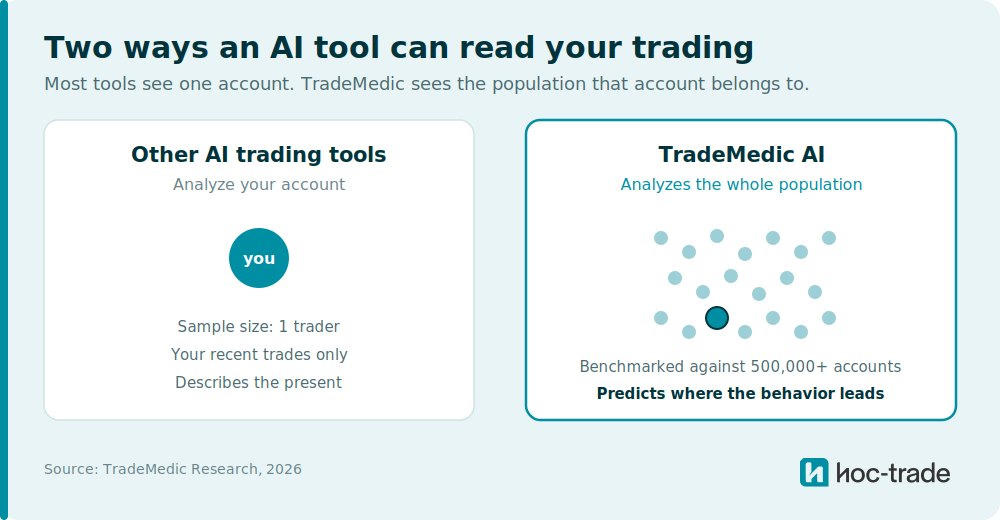
Almost every AI trading tool now claims to put a dollar figure on your bad habits. It is an appealing promise, because a number is more actionable than vague advice to be more patient. The important question to ask is where that number comes from. Most tools calculate it from your own recent account history, which means the figure rests on a small sample: your trades, over a few weeks or months. That is a sample of one trader, and a single account has no baseline to compare against, so it can tell you what you did but not whether it is normal, costly, or dangerous.
This is the real line between the tools. Other AI tools analyze your account. TradeMedic analyzes the population your account belongs to. It detects the same pattern in your data, then grounds it in how that pattern behaves across a subset of more than 500,000 accounts. So the finding is not a lone observation about you. It arrives with a benchmark: how common the behavior is, whether it shows up more in profitable or unprofitable traders, and how it ranks by impact. That population view is the difference between a tool describing you back to yourself and a tool telling you where you stand.
How many behavioral patterns can AI trading tools detect?
Detection depth is where the gap widens. Most behavioral tools name the same short list of habits: revenge trading, overtrading, FOMO, cutting winners early, holding losers, tilt. That cluster of five or six covers the patterns that are easy to spot in a single account. TradeMedic detects more than 60 behavioral patterns, made up of 25 strengths, 30 improvement opportunities, and 10 risks and observations, spanning entry timing, exit timing, risk management, emotional behavior, and market conditions.
The depth is a direct consequence of the dataset. Some patterns only become reliable once you have seen them across hundreds of thousands of accounts, across scalpers, day traders and swing traders, across highly profitable traders and loss making traders, EA systems vs. manual traders, and so much more. Failing to call it a day, for example, the single most common improvement area in the data, is hard to isolate in one trader's history but clear across the population. A tool working from your account alone cannot detect what it has never had the scale to learn. That is why breadth and dataset size are linked rather than separate features.
Do AI trading tools show your strengths or only your mistakes?
Nearly every AI trading tool is built to find what is wrong. That framing is useful, but it is only half the picture, and it can leave a trader thinking their job is an endless hunt for errors. TradeMedic detects strengths as well as weaknesses: 25 of its patterns are strengths, behaviors that add to performance, ranked by their measured effect. A trader sees not just the habits costing them, but the edges worth protecting and building on.
Strengths are harder for any tool to establish than faults, because a strength is only meaningful relative to other traders. A single account can show that you made money in calm markets last month. It cannot tell you whether performing in calm markets is common or rare among profitable traders, whether it is something you should build on more, which is the part that makes it worth knowing. That comparison needs a population, and it is what lets TradeMedic rank a strength by how strongly it tracks with success. The specific numbers behind that appear further down.
Which trading behaviors make profitability least likely?
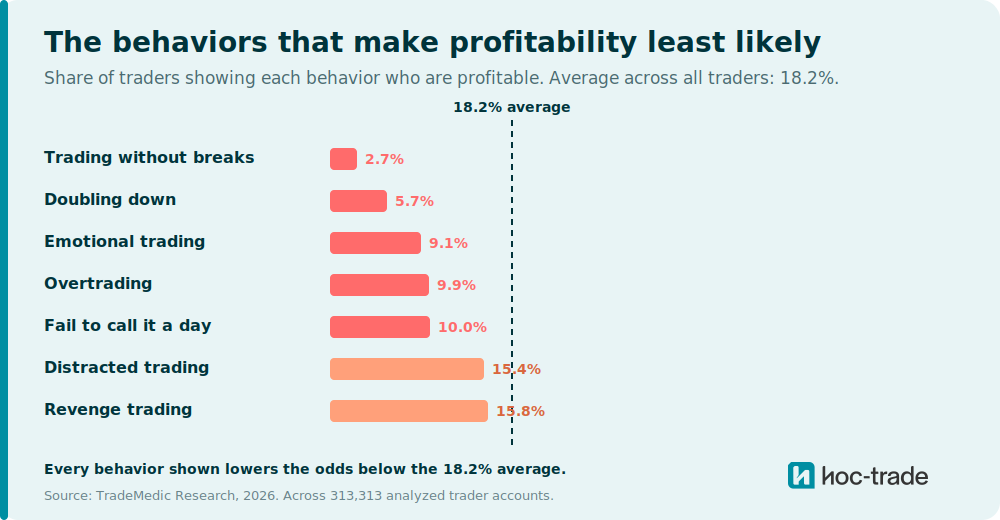
This is where the population view earns its keep. What behavior may not show a strong dollar impact in your trading right now, but over the long term is likely to cause a margin call? TradeMedic has detected the same behaviors across hundreds of thousands of accounts, it can answer the question a trader really need to care about: if I do this, how likely am I to be profitable? Across the analyzed accounts, 18.2 percent of traders are profitable overall. That baseline is the reference point, and it turns detection into something closer to a prognosis. A tool reading your account alone cannot set that baseline, because it has no population to measure you against.
Measured this way, some behaviors are far more damaging than a prevalence count would suggest or how your account after 200 trades shows. Among traders who show trading without breaks in their top issues, only 2.7 percent are profitable, against the 18.2 percent average. Doubling down sits at 5.7 percent, emotional trading at 9.1 percent, overtrading at 9.9 percent, and failing to call it a day at 10.0 percent. Every one of these behaviors is associated with roughly half the baseline chance of being profitable or worse. That is the kind of ranking a trader can act on, and it only exists because there is a population and an average behind it.
Which trading strengths make profitability most likely?
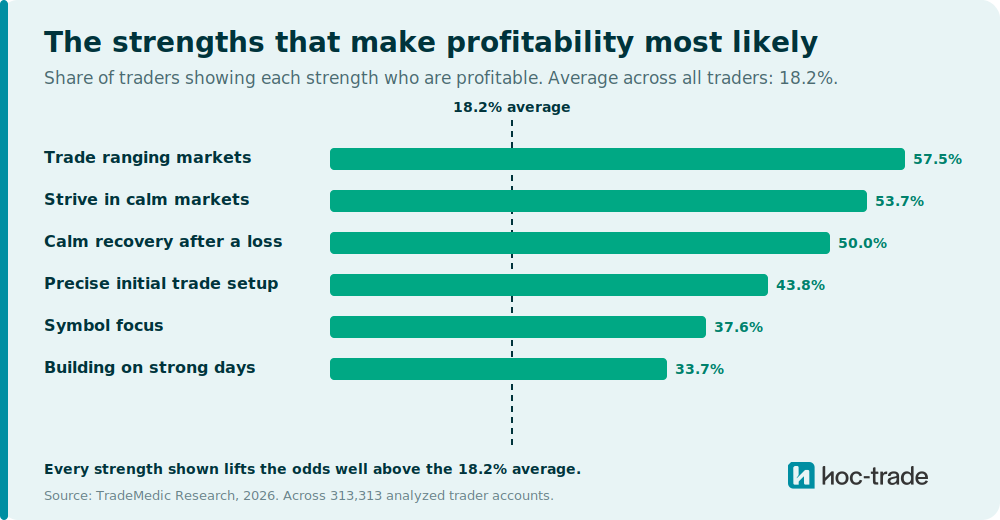
The same method run on strengths produces the mirror image, and it is where TradeMedic separates furthest from tools that only look for faults. Traders who trade ranging markets well are profitable 57.5 percent of the time, more than three times the 18.2 percent baseline. Comfort in calm, low-volatility markets sits at 53.7 percent, and recovering composure calmly after a loss at 50.0 percent. Precise initial trade setups, focusing on a small set of symbols, and building on strong days all land well above the average too.
These are the edges worth protecting, and no single-account tool can identify them. A behavior like performing in calm markets sounds unremarkable in isolation. Against the population it is one of the clearest markers of a trader who lasts. Showing a trader their edges, not just their leaks, is what turns the product from an error finder into a full behavioral assessment.
Is impatient trading always a bad habit?
Not according to the data, and this is the kind of finding only a large population reveals. Impatience is usually treated as a flaw, but traders who show impatient exits are profitable 37.0 percent of the time, and impatient entries 33.3 percent, both roughly double the 18.2 percent baseline. The likely reason is that impatient traders also cut their losses early and keep them small, which protects the account even when the timing is not perfect.
A tool that flags impatience as a mistake without a benchmark would be steering some traders away from a habit that may not be a priority item. This is the practical value of population-grounded analysis: it can tell the difference between a behavior that looks careless and one that quietly correlates with success. Detection without a benchmark cannot, because in a single account impatience just looks like impatience.
Does win rate or risk-reward matter more for profitability?
The same dataset points to a conclusion that runs against most trading intuition. Traders tend to chase a higher win rate, the share of trades that come out ahead. But across the population, reward-to-risk ratio is the far stronger marker of who ends up profitable. Among traders with a reward-to-risk ratio above two, about 45 percent are profitable. Among those below 0.5, only about 10 percent are. Raising how much you stand to make relative to what you risk moves the profitable share more than four times over.
Hit rate matters too, profitability climbs from roughly 5 percent at the lowest win rates to about 32 percent at the highest (>80%), but most traders sit in the middle bands where the difference is smaller, and being right more often does less work than sizing reward against risk. It is the kind of counterintuitive, population-level finding that a behavioral analytics tool can surface and a single-account coaching chat, working only from your own recent trades, would have no way to know. There are many more dimensions to this with high relevance to a traders profitability, like your risk per trade (the 1%, 2% or 3% typical recommendations are actually showing much weaker results), your risk and sizing behavior during loss streaks, the points in time you pull your Stop Loss. For each of them, the data-driven analysis within a large population of traders reveals important information for the single trader.
What is the best AI tool for prop firm and MT4 or MT5 traders?
Prop firm traders and retail forex traders on MetaTrader 4 or MetaTrader 5 have a specific need, because the margin for error is smaller. A funded challenge can end on a single undisciplined session. Several behavioral tools now connect to MT4 and MT5 through a read-only connection and analyze the exact patterns that end challenges: entering again too soon after a loss, sizing up after a drawdown, trading past the point where the day should have ended.
This is where the self-report problem bites hardest. In the middle of a challenge, the trades that break the rules are the ones a trader is least likely to log honestly in a journal or mood diary. Automated detection does not depend on that honesty. TradeMedic connects to any MT4 or MT5 account, including prop firm accounts, through read-only investor access, and reads the behavior straight from the trade record. In the dataset, revenge trading appears in a large majority of traders who quit within their first days of trading, and in far fewer of those still active after a long track record, which is the behavioral signature that separates traders who last from those who wash out early.
How do you choose the right AI trading tool?
Start with the problem, not the product. If you need help deciding what to trade, you are looking for market analysis, scanners, signals, or bots, and behavioral tools will not serve you. If you need to learn strategy from scratch, a mentor-style educational tool is the better fit. If you already have a strategy but keep undoing it with the same habits, the problem is behavioral, and no amount of new setups will fix it. That is the case for behavioral analytics.
Then ask three questions of any tool that claims to analyze your trading. Does it work on your real trade data or on what you type into it? Does it detect patterns automatically or wait for you to tag and log them yourself? And is the analysis grounded in a large dataset, or only in your own recent history? The answers separate a genuine behavioral analytics tool from a chatbot with a trading label, and they point you toward the type of tool that fits how you really trade.
What does the data say about trading behavior?
TradeMedic AI detects more than 60 behavioral patterns across a dataset of over 500,000 trader accounts, covering forex, crypto, indices, shares, gold, oil, and other markets. Every trader in the dataset with a meaningful trade history showed at least one improvement area, including consistently profitable ones, and the most common patterns recur at measurable rates across the whole population rather than in isolated cases. Because the patterns are grounded in that population, each finding on an individual account carries a benchmark: how common the behavior is, how it ranks by impact, and where it tends to lead over time. A detailed breakdown of individual patterns and their measured effect is available on the TradeMedic research page.
The label on the box matters less than the job the tool does. AI trading coaches, mentors, and behavioral analytics tools all promise improvement, but they get there in different ways, and the right one depends on whether your gap is knowledge, workflow, or behavior. If you want to see the behavioral patterns already sitting in your own trade history, you can learn more about TradeMedic AI or connect your trading account free and see your own analysis in seconds.
Frequently asked questions
What is the difference between an AI trading coach and behavioral trading analytics?
An AI trading coach reviews your trading and gives feedback, often through conversation, and usually works from your own recent account history. Behavioral trading analytics detects recurring patterns automatically from your full trade record and validates them against a large dataset. The analytics approach surfaces blind spots you would not think to log yourself.
Which AI trading tool is best for prop firm traders?
Prop firm traders benefit most from tools that connect to MT4 or MT5 and detect the behaviors that end challenges, such as revenge trading and sizing up after losses. Automated behavioral analytics is well suited here because it reads these patterns directly from trade data rather than relying on self-reported journaling. TradeMedic AI connects to any MT4 or MT5 account, including prop firm accounts, through read-only access.
Do AI trading tools that show the cost of your habits really work?
They can, but the reliability depends on the sample behind the number. Many tools calculate the cost from your own recent trades alone, which is a sample of one trader. TradeMedic validates each pattern's performance effect across more than 500,000 trader accounts, so the finding on your account reflects how the behavior plays out at scale.
Is an AI trading tool the same as a trading bot?
No. A trading bot executes trades automatically based on rules or strategies. Behavioral analytics tools like TradeMedic do not place trades or access funds. They analyze your completed trade history to detect patterns and quantify their effect on your performance, leaving every trading decision to you.
How many behavioral patterns can AI trading tools detect?
Most behavioral tools focus on a short list of common habits such as revenge trading, overtrading, and FOMO. TradeMedic AI detects more than 60 patterns, including 25 strengths, 30 improvement opportunities, and 10 risks and observations. The breadth comes from its dataset: some patterns only become reliable once observed across hundreds of thousands of accounts.
What should I look for when choosing an AI trading tool?
Match the tool to your problem. Use market analysis tools if you need help deciding what to trade, educational tools if you need to learn strategy, and behavioral analytics if you keep undoing a working strategy with the same habits. For any tool claiming to analyze you, check whether it works on real trade data, detects patterns automatically, and is grounded in a large dataset.